Numerous private companies venturing into space technologies are fueling rampant innovation. Radical business models and cutting-edge technological innovations are foreseeing the digitization of space ventures and making access to space, cost effective, faster, and reliable. From ground control and support to data gathering and analysis to launching satellites into orbit, the space industry is witnessing a large influx of global corporate leaders who are providing services, technologies, and improvements. Resembling the fast paced impact that semiconductor technologies had on global businesses, the now horizontal economy is seeing governments investing in numerous start-ups that provide a range of Space tech solutions.
Space launch companies gained massive popularity in the public eye but the depth of innovations extend beyond the logistics. Over the years, access to GPS technologies opened doors to new economies and caused widespread disruptions in different sectors. Today’s advancements in augmented reality, artificial intelligence, and blockchain technologies are set to bring such disruptions to space technologies with speed and reliability. Digital innovations and integrations are emerging through space tech start-ups that exploit hardware technologies through software to attain better performance and achieve more missions. Companies leverage AI to process sensory and weather data, and these capabilities are deemed to play a vital role in enhancing business processes, user-machine interface, and even hiring.
Satellites are shrinking and these micro and nano-satellites bring unmatched cost benefits to companies seeking access to space. The broadband industry is set to undergo a major shift with proposals of global internet connectivity from space gaining traction. With companies offering operational assistance for functions like satellite-constellation management and ground networks, businesses can outsource certain tasks, allowing greater cost savings in terms of infrastructure management and operation. This allows companies to refine their business models and be more competitive in the cut-throat space market.
The capabilities of augmented reality and machine/ computer vision enable smarter interfaces and ensure swift data delivery, reduce costs of training, and improve mission accuracy. These technologies focus on enhancing user experience in the aspects of data communication through new methods. The industry has players who strive to create constellations for globally accessible internet and provide ground station services that bring orbital satellite connectivity to ground units. Satellites equipped with the appropriate sensors and equipment can provide monitoring and imaging capabilities to companies in different industries.
Despite rocket companies gaining recognition in the space race, the logistics services they provide contribute to a tiny fraction of the space economy. Technologies that communicate with satellites, leverage data, process information, and enable functonalities like broadband, reconnaissance, weather monitoring, positioning, and observation are major contributors to the industry’s revenue.
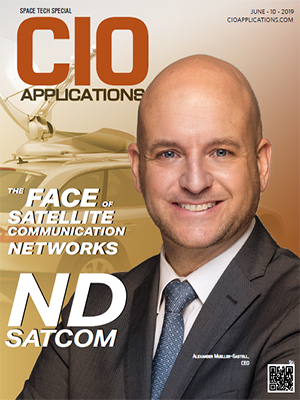
To help CIOs navigate through the list of space tech solution providers, our distinguished selection panel, comprising CEOs, CIOs and VCs, industry analysts and the editorial board of CIOApplications narrowed down the 10 most promising space tech solution providers 2019 that exhibit competence in leading space technologies.
We present to you CIOApplications’ “Top 10 Space Tech Solution Providers 2019.”